Plant for drought
Selected drought-hardy plants for the dry, gravelly site.
Water harvesting and food growing at Mzomoyethu Crèche: tanks, swales and a holding pond supply protected growing areas, with irrigation monitored using a timer and water meter.
The close-out record describes a dry, gravelly site with limited water. The garden needed runoff capture, water storage, drought-hardy plants and irrigation suited to these conditions.
Selected drought-hardy plants for the dry, gravelly site.
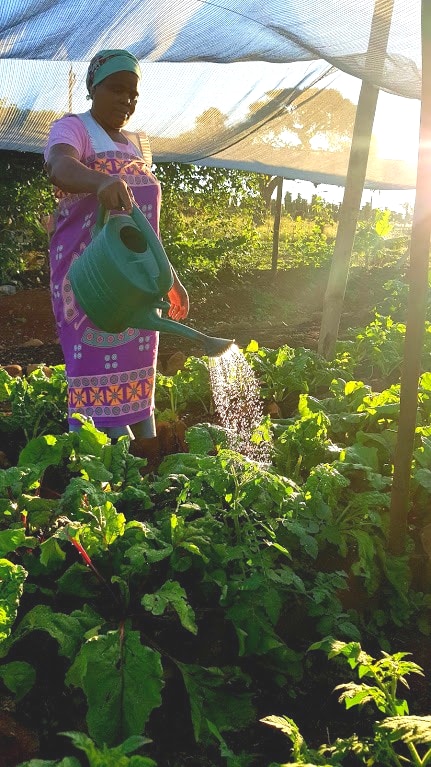
Used shade and tree protection to reduce establishment losses under severe conditions.
Introduced a timer and a water meter to control and measure irrigation.
Fine-tuned watering through continued field observation and mentorship.
Connected the site work to the wider Mandlakazi practical-training programme, which included five-day permaculture courses in each community.
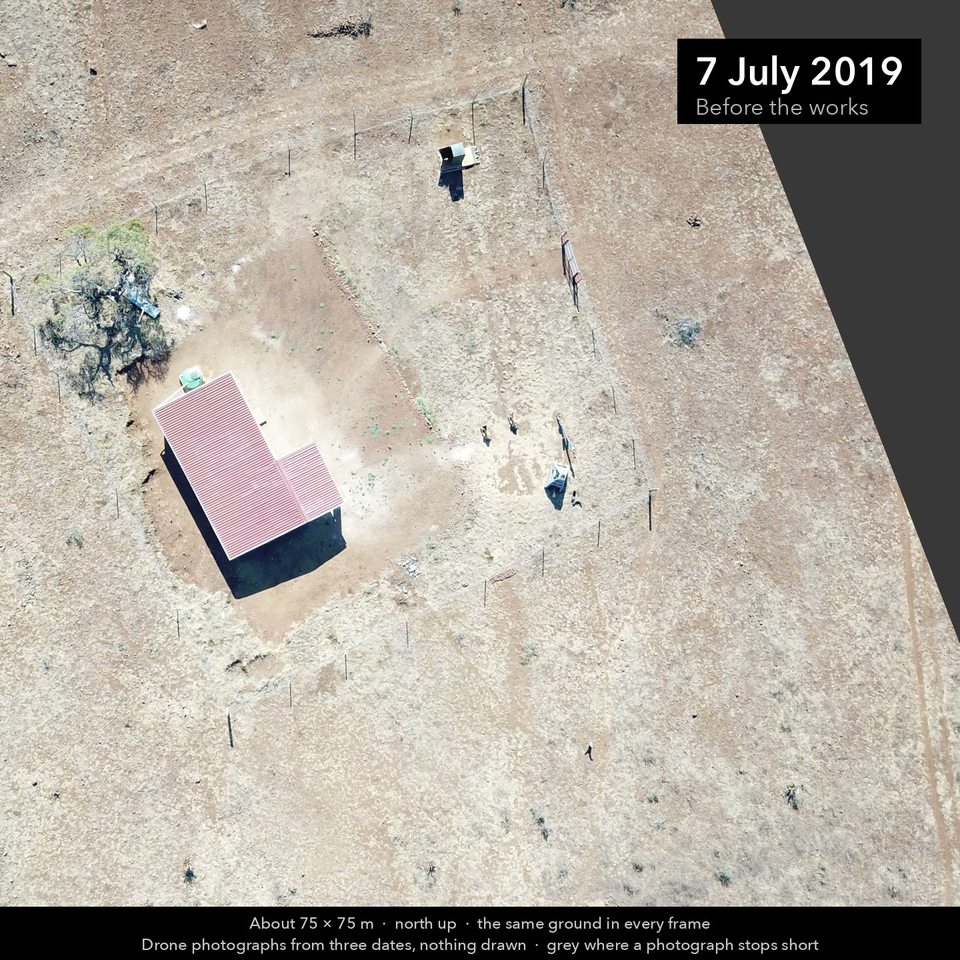
Aerial comparison of Mzomoyethu Crèche in July 2019, November 2020 and June 2022, showing the installation of swales, a pond, tanks and shade cloth around the garden. All three photographs cover the same 75 by 75 metre area. Grey corners mark areas outside the original photographs.
Silent loop, north up, about 75 by 75 metres of the same ground in every frame. Each change stops half way, the earlier date on one side and the later on the other. July 2019, before the works: dry, bare ground around the crèche building and its fenced yard. November 2020: swales and berms, the pond south of the building, shade cloth over the garden and tanks beside the building. June 2022, after the works: the garden under and beside the shade cloth. Then back to July 2019.
The October 2019 earthworks and hydrology plan alongside aerial photographs from July 2019 and June 2022. The plan shows proposed swales, basins, tanks, pipework and a pond.
Silent loop, north up. Each change stops half way, the two frames side by side. July 2019, before the works. October 2019, the design: the earthworks and hydrology sheet over the same photograph, with fence beds, large tree basins, raised vegetable beds, crescent tree basins, berms, swales and diversion mounds, the tanks, pipes and pond, and drip irrigation. June 2022, after the works. Then back to July 2019.
Water moving through the second swale between the food forest and vegetable garden at Gudlintaba Crèche, with vegetation established around it.
Water coming to the swale. This is the second swale. Look at this, man—look at the swale. It is in the garden. This is the swale between the food forest and the vegetable garden. Look at the garden—everything is green. You see, the green is coming, although parthenium is all over.



Mzomoyethu Crèche Food Garden Closeout Report and Mandlakazi programme reports. Used to verify the design layers, field conditions and implementation record.
Rory’s updated project record identifies Mzomoyethu as the Gudlintaba crèche, so this dossier uses the name “Mzomoyethu Crèche · Gudlintaba”. The source drawing spells it “Mzamoyethu”.
Gudlintaba drone film in the project archive. The title provides site-level attribution.
Drone photographs from three dates registered to one 75 by 75 metre north-up frame: the July 2019 underlay of the October 2019 earthworks and hydrology sheet, an 8 November 2020 nadir flown at 84 m with its south-east corner completed from a second frame of the same flight at 124 m, and the 28 June 2022 nadir flown at 81 m. The design comparison adds the proposed October 2019 earthworks and hydrology plan over the same ground.
Official biography used to verify Kingsley Holgate’s identity and the foundation’s early-childhood-development work.
Programme record naming Mbuzeli, Mzamoyethu and uBhejane crèche work and providing context for the programme photograph.
Records Kingsley Holgate joining a week of repairs and repainting at supported crèches.
ImbewuField brings farm planning, learning and useful records into one connected tool for growers and programme teams.
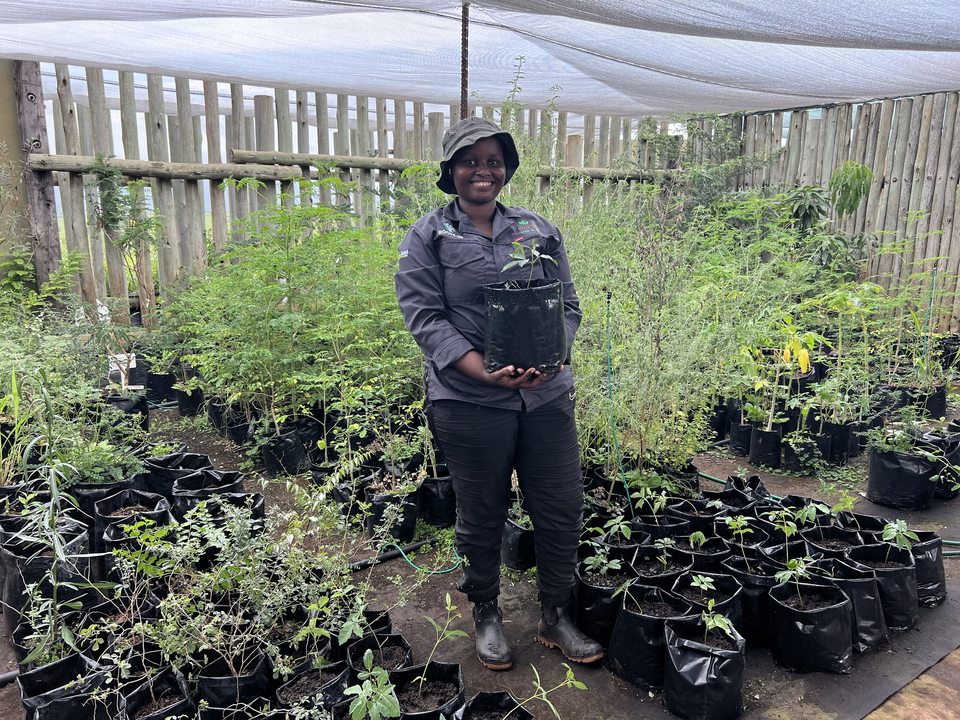
Three community crèche gardens grew into a practical system for training, food production, water harvesting and local plant propagation.
Read the case study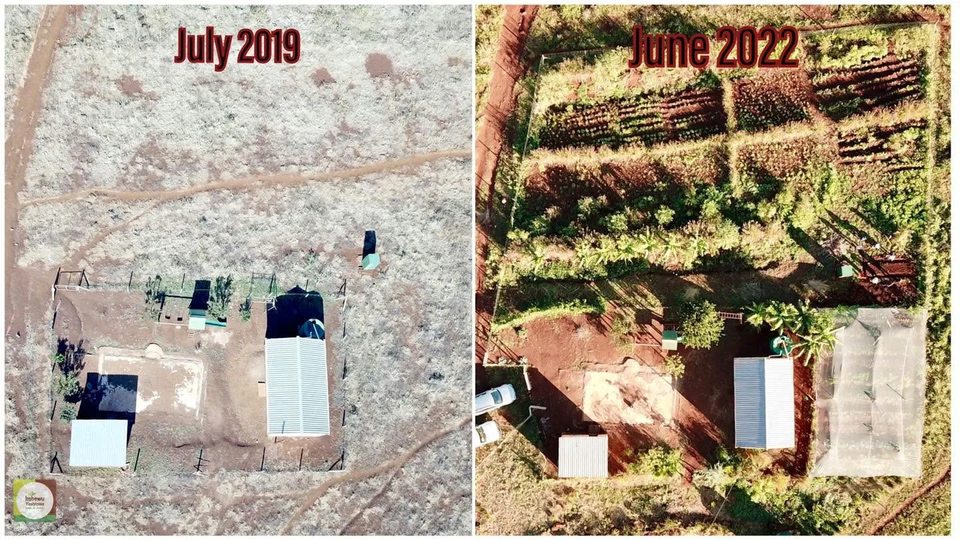
A crèche garden in KwaZulu-Natal with municipal water storage, swales, protected vegetable beds and a propagation nursery, documented from 2019 to 2022.
Read the case study